Fastest Real-Time Results API: How Speed Impacts User Experience
In today's digital world, speed matters more than ever.
Whether a website is displaying live information, an application is updating continuously, or a dashboard is receiving data from an external service, users expect information to appear quickly. Even a small delay can make an application feel slow or unreliable.
This is where a fast real-time API becomes important.
An API doesn't just transfer data between two systems. The performance of that API directly affects how quickly users see updated information on a website or application.
For businesses and developers working with real-time data, choosing an API with fast response times, reliable uptime, secure data handling and webhook support can make a significant difference.
What Is a Real-Time Results API?
A real-time results API is a technology that allows an application or website to automatically retrieve updated information from a data provider.
Instead of manually entering information into a website or application, developers can connect their software with an API.
The API then delivers structured data that can be processed and displayed inside the application.
For example, a typical API request may look like:
GET /api/results
The server processes the request and returns updated information in a structured format such as JSON.
This makes it possible for developers to build dashboards, websites and mobile applications that update information automatically.
Why API Speed Matters
Imagine a user is looking at a website expecting updated information.
If the application takes several seconds to display the latest data, the experience can feel slow.
Now imagine hundreds or thousands of users making requests at the same time.
A poorly optimized API can become overloaded, resulting in:
- Slow response times
- Failed requests
- Timeout errors
- Outdated information
- Poor user experience
- Increased server load
A properly optimized API, on the other hand, can deliver information quickly and consistently.

API Response Time Explained
API response time is the amount of time required for an API request to receive a response from the server.
For example:
Request Sent
↓
API Server
↓
Data Processing
↓
Response Generated
↓
Application Receives Data
The faster this entire process happens, the faster the application can display updated information.
However, response time can depend on several factors, including:
- Server location
- Network latency
- Database performance
- API architecture
- Request volume
- Data processing
- Caching
- Server resources
This means that simply having an API isn't enough. API infrastructure and optimization are equally important.
Real-Time Data vs Traditional Polling
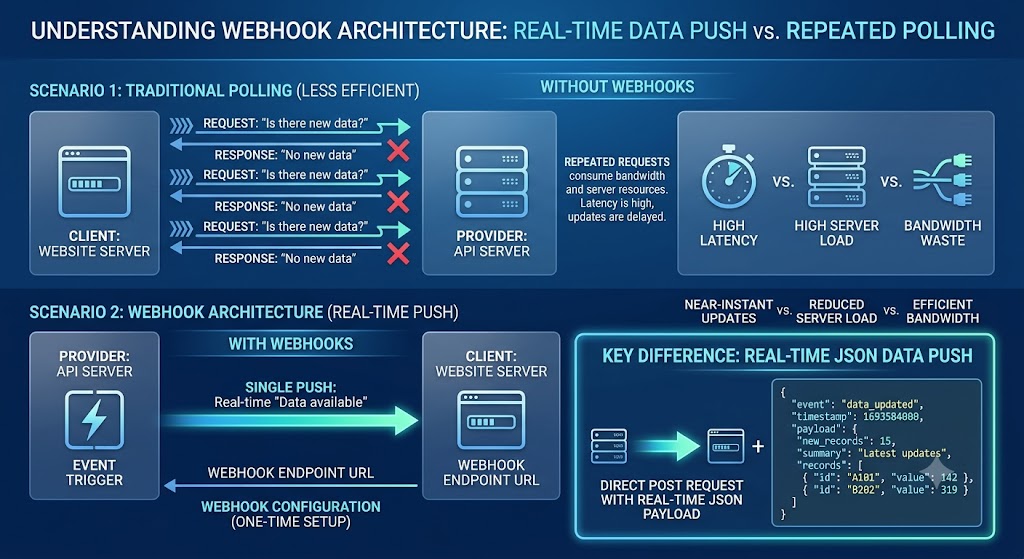
One common way applications receive updated information is through polling.
With polling, the application repeatedly asks the API:
"Is there any new data?"
For example:
Request → API
Request → API
Request → API
Request → API
Although this approach works, it can create unnecessary API traffic.
If the information hasn't changed, the application is still making requests.
This can increase server load and consume API resources.
How Webhooks Improve Real-Time Data Delivery
Webhooks provide another approach.
Instead of continuously asking the API for new information, your application provides a webhook URL.
When new information becomes available, the API provider sends the updated data directly to that URL.
The process looks like this:
New Data Available
↓
API Provider
↓
Webhook
↓
Your Server
↓
Website / Application
This can significantly reduce unnecessary API requests and make real-time data delivery more efficient.
Why Webhooks Are Important for High-Traffic Applications
When an application has a large number of users, continuously polling an API can generate a huge number of requests.
For example, suppose an application checks an API every 5 seconds.
That means:
12 requests per minute
720 requests per hour
17,280 requests per day
And that's for one client.
With multiple applications and users, the number can increase very quickly.
Webhooks can reduce unnecessary polling because data is delivered when an event occurs.
This creates a more efficient architecture.
API Uptime Is Just as Important as Speed
A fast API isn't useful if it frequently goes offline.
That's why uptime is another important factor when evaluating an API provider.
For applications that depend on continuously updated information, downtime can result in:
- Missing updates
- Failed API requests
- Empty pages
- Delayed information
- Poor customer experience
A reliable API infrastructure should therefore focus on both speed and availability.
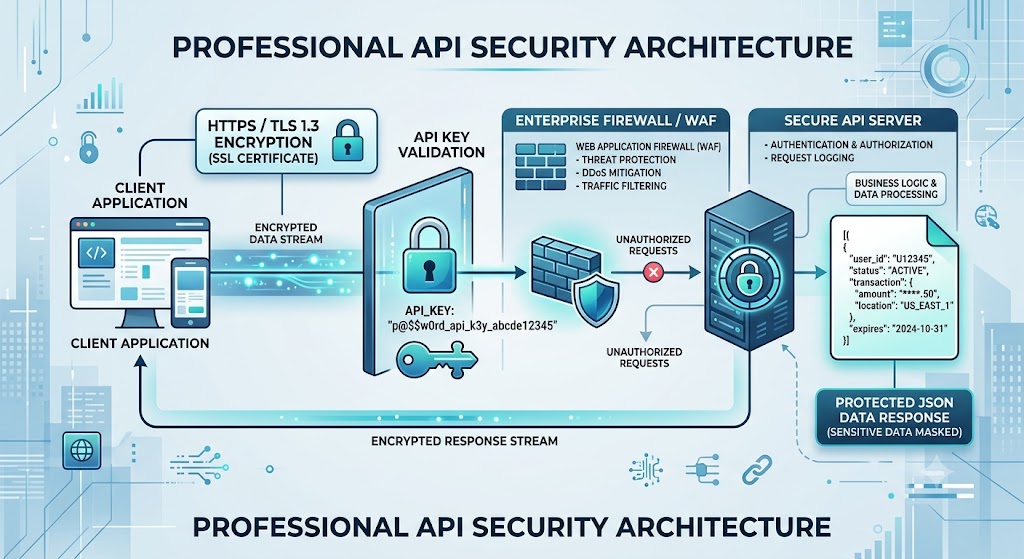
Security and Data Handling
Speed should never come at the cost of security.
A professional API infrastructure should use appropriate security practices for protecting data and API access.
Important considerations include:
API Authentication
API keys or other authentication mechanisms can help ensure that only authorized applications access the service.
HTTPS
Encrypted HTTPS connections help protect data while it travels between the application and API server.
Rate Limiting
Rate limiting helps prevent excessive requests from overwhelming the infrastructure.
Secure Server Infrastructure
Servers should be properly configured and monitored to minimize security risks.
Easy API Documentation Makes Integration Faster
Another factor that developers often overlook is documentation.
Even a technically excellent API can become frustrating if its documentation is confusing.
Good API documentation should clearly explain:
- Authentication
- API endpoints
- Request parameters
- Response format
- Error codes
- Examples
- Webhook configuration
- Integration steps
For example, developers should be able to quickly understand what an endpoint does and what response they can expect.
A simple documentation structure can save developers hours of unnecessary troubleshooting.
What Makes a Good Real-Time API?
When evaluating a real-time API provider, developers should look beyond just the advertised speed.
Consider these factors:
| Feature | Why It Matters |
|---|---|
| Fast response time | Reduces waiting time |
| High uptime | Keeps applications available |
| Webhooks | Enables event-based delivery |
| Secure authentication | Protects API access |
| Good documentation | Makes integration easier |
| Scalable infrastructure | Handles increasing traffic |
| Error handling | Makes troubleshooting easier |
| Technical support | Helps resolve integration issues |
| Affordable plans | Controls development costs |
A combination of these features generally provides a much better developer experience than focusing on only one metric.
How Fast APIs Improve User Experience
From a user's perspective, they don't really care about API architecture.
They care about what they see.
They want:
Fast loading.
Fresh information.
Fewer errors.
Smooth interaction.
When an application receives data quickly, the interface can update faster.
This creates a smoother experience and makes the software feel more responsive.
In competitive digital products, these small improvements can make a meaningful difference.
Choosing the Right API Provider
Before integrating any real-time API, developers should test the service rather than relying only on marketing claims.
Look for:
- Consistent response times
- Reliable uptime
- Clear documentation
- Webhook availability
- Secure authentication
- Scalability
- Transparent pricing
- Developer support
- Proper error responses
- Simple integration process
It is also a good idea to test the API under different network conditions and different request volumes.

Final Thoughts
A real-time API is more than a connection between two systems.
It is an important part of the overall user experience.
Fast response times, reliable infrastructure, high uptime, secure data handling and webhook-based delivery can help applications provide information with less delay and fewer unnecessary requests.
For developers building modern websites, mobile applications and dashboards, choosing the right API architecture from the beginning can save both development time and infrastructure costs later.
The best API isn't necessarily the one claiming to be the fastest. It is the one that provides a good balance of speed, reliability, security, scalability, documentation and support.
FAQs
What is an API?
An API, or Application Programming Interface, allows two different software systems to communicate and exchange data.
What is API response time?
API response time is the amount of time between sending a request to an API and receiving its response.
Why is API speed important?
Faster API responses allow applications to display information more quickly, improving responsiveness and overall user experience.
What is a webhook?
A webhook allows a server to automatically send information to another server when a specific event or update occurs.
Is a webhook better than polling?
For event-driven updates, webhooks can be more efficient because the receiving application doesn't need to repeatedly ask whether new data is available.